
Mandatory Signs UAE | Complete Guide to Road Safety Signs & RTA Rules
I still remember the first time I got behind the wheel in Dubai. It was my third week in the UAE, and I took a wrong lane on Sheikh Zayed Road because I did not fully understand what a blue circular sign was telling me to do something I later learned falls under Mandatory Signs UAE.
A kind driver honked, I corrected my lane, and I spent the rest of that evening with the RTA traffic guide open on my kitchen table. That one mistake pushed me to learn every single road safety sign in the UAE the mandatory rules, warning signs, RTA signs, guide signs, the works.
If you are driving in the UAE whether you are a new resident, a visitor renting a car, or preparing for your RTA theory test understanding mandatory signs UAE is not optional. It is the difference between safe, legal driving and a fine that shows up on your Emirates ID before you even get home.
From Driver Affairs regulations covering RTA signs on Sheikh Zayed Road to road safety signs on desert highways, every sign carries a legal meaning you are responsible for knowing.
Quick Overview of UAE Traffic Signs (For Fast Understanding)
Before going deep, here is what you need to know at a glance:
What are mandatory signs UAE?
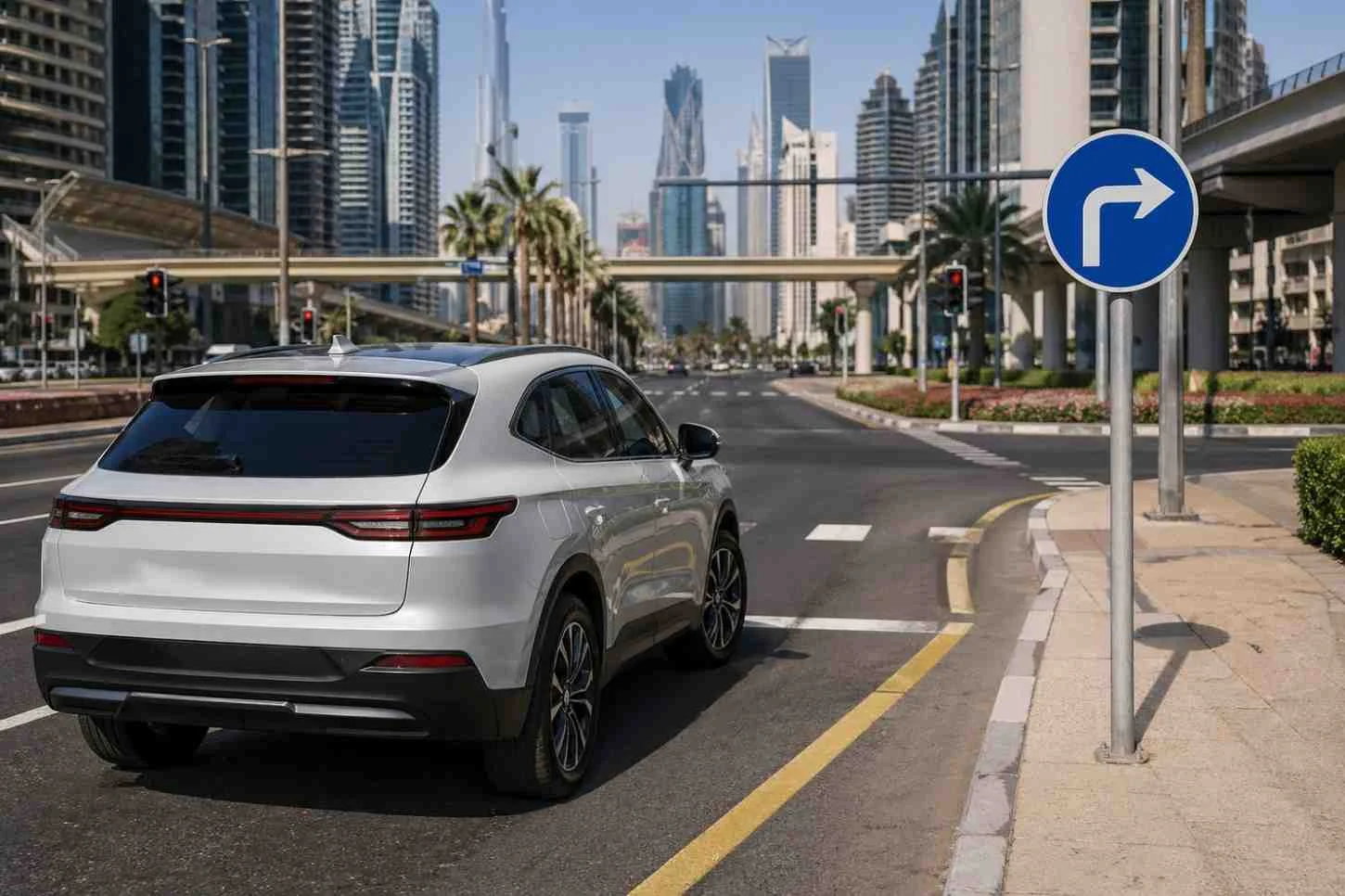
Mandatory signs are blue circular signs that tell you what you must do. They give a command not a suggestion. Turn right, go straight, keep left, maintain minimum speed. You follow them or you get fined.
Main categories of road safety signs in UAE:
- Regulatory signs: The law of the road (includes mandatory, control, and prohibitory signs)
- Warning signs : hazard alerts ahead
- Guide signs : navigation and directional information
Why every driver must understand road safety signs in UAE?
The UAE hosts over 9 million vehicle movements daily across Dubai, Abu Dhabi, Sharjah, and beyond. With a highly diverse population of residents and tourists behind the wheel, RTA signs are the one universal language on the road.
Ignoring them does not just risk a fine it risks lives. Every category of road safety signs in UAE from mandatory to warning to guide plays a distinct role in keeping traffic moving safely.
Why Mandatory Signs in UAE Matter for Road Safety?
When I started observing how Dubai roads function versus other cities I had driven in before, one thing became immediately clear, the UAE road system is built on precision. Every sign has a purpose, a placement, and a legal weight behind it.
Role of RTA Signs in Accident Prevention
The Roads and Transport Authority (RTA) in Dubai and the Integrated Transport Centre (ITC) in Abu Dhabi have designed a bilingual sign system Arabic and English that follows international standards. This matters because the UAE has one of the most diverse driving populations in the world.
A Pakistani expat, a British tourist, and an Emirati national all share the same highway. RTA signs and road safety signs act as the common rulebook that applies equally to everyone.
When a mandatory sign tells you to keep left, it is not decorating the road. It is directing traffic flow to prevent head on collisions. When a warning sign shows a camel crossing ahead, it is telling you that an unexpected animal could be standing in your lane around the next turn. These are not hypothetical they are daily realities on UAE roads.
Legal Importance Under UAE Traffic Law
Under UAE federal traffic law, regulatory signs are legally binding directives. You are breaking the law if you do not follow them. The only exception is when a police officer is physically directing traffic at a junction in that case, the officer’s instruction overrides the sign.
Fines for violating mandatory signs UAE can reach AED 1,000 per offense, with black points added to your driving record. Accumulate 24 black points within a year and your license gets suspended. The RTA signs system is backed by smart camera enforcement violations are logged automatically before you even reach your destination.
Real-Life Impact on Driving Decisions
Think about a “Turn Right Only” sign at a junction. If you ignore it and go straight, you are not just violating a rule you are crossing into oncoming traffic or an area the road was not designed to handle. That is how accidents happen. Understanding the signs turns you from a reactive driver into a proactive one.
Main Types of Road Safety Signs in UAE
The UAE’s sign system is modelled on the British road sign system and uses a structured approach that groups signs by their function. Understanding all road safety signs in UAE starts with knowing these main categories. Here is a breakdown the same structure you will find referenced in official RTA signs documentation:
Regulatory Signs (Core Driving Rules)
Regulatory signs are the authority on the road. They fall into four groups mandatory signs UAE, control signs, prohibitory signs, and parking control signs. On freeways, a separate freeway control signs category also applies. Together, these regulatory signs cover every scenario where driver action is legally required.
Mandatory Signs UAE
These are circular signs with a blue background and white symbols. They represent a required action. You must comply there is no ambiguity. Common examples include:
- Ahead Only: you must go straight
- Turn Right / Turn Left: you must turn in that direction
- Pass Either Side: you can navigate around an obstacle from either side
- Roundabout: follow the indicated circular direction
- Minimum Speed Limit: you must not drive slower than the posted number
The blue circle is the visual language of obligation. When you see it, your job is to follow it, not question it.

Control Signs (Stop, Give Way)
Control signs manage right-of-way and traffic flow at critical decision points:
- Stop Sign: a red octagon with “STOP” in Arabic and English. You must come to a complete halt, check that the road is clear, and only then proceed.
- Give Way (Yield): a triangular sign requiring you to let crossing traffic or pedestrians pass first.
- No Entry: a red circle with a white horizontal bar. This road is off limits to you. On a highway, this often signals a one way road or restricted zone.
- You Must Go This Way: directs you into a compulsory lane or direction, commonly used at roundabouts and exit only lanes.
Prohibitory Signs (No Entry, No U-Turn)
Prohibitory signs use red circles or red borders to tell you what you are not allowed to do:
- No U-Turn: making a U-turn here is forbidden
- No Overtaking: do not pass the vehicle in front of you
- No Parking: you cannot leave your vehicle in this space
- No Honking: horn use is prohibited (hospital zones, certain residential areas)
- Maximum Speed Limit: the highest speed allowed on that road
The red border is the visual signal of restriction. Think of it as a wall you do not go through it.
Warning Signs (Hazard Awareness)
Warning signs are triangular with a red border. They do not give a command they give you information about what is coming so you can adjust your driving. These come in several types:
General Warning Signs
These cover broad hazard categories: sharp curves, speed bumps, narrow roads, slippery surfaces, and pedestrian crossings. When you see a triangle, slow down mentally and start scanning the road ahead.
Advanced Warning Signs
These appear further ahead of the actual hazard giving you more time to react. You will see them before a blind junction, before a school zone, or before a section with frequent lane merges.
Diagrammatic Warning Signs
These use illustrations to explain specific scenarios, such as a T-junction, a Y-junction, or a road that splits unexpectedly. Rather than reading text, your brain processes the picture which is faster at 120 km/h on Emirates Road.
Hazard Marker Signs
Placed directly at the point of danger – bridge edges, traffic islands, road barriers, sudden narrowing. They are your final visual cue before you physically encounter an obstacle.
Guide Signs (Navigation & Directions)
Guide signs are the navigational backbone of UAE roads. They are mostly rectangular and use color coding to differentiate route types. I relied on these heavily when I was still learning to navigate between emirates.
Mandatory Signs UAE Explained (With Meanings & Examples)
This is the section most drivers need to study carefully. Mandatory signs carry legal weight and are tested heavily in the RTA theory exam. Here is what makes them distinctive and how to respond to each one correctly.
What Makes a Sign “Mandatory”
A mandatory sign has three consistent features:
- Shape: always circular
- Color: always blue background with white symbol
- Function: always a command (not a warning, not a prohibition)
If you see a circular blue sign, your instinct should be: what am I being told to do right now?
Common Mandatory Signs and How to Respond?
Turn Left Only / Turn Right Only: You must turn in the indicated direction at that junction. If you realize too late that you wanted to go straight, do not force it at the last second complete the turn safely and find a place to turn around ahead. Last second lane changes caused by misread signs are one of the most common causes of minor collisions in Dubai.
Straight Ahead Only: You cannot turn left or right. Your lane is committed to going forward. Check for this sign before entering a lane, especially in complex intersections where some lanes are straight-only and others allow turns.
Minimum Speed Limit: This one surprises many new drivers. The sign shows a number inside a blue circle, and it means you cannot drive slower than that speed. On UAE highways, this is common minimum speeds are enforced to prevent dangerous slow moving vehicles blocking fast-lane traffic.
Keep Left / Keep Right: Directs you around an obstacle or road divider. If you see “Keep Right” with an arrow, you must move to the right of the upcoming barrier. Passing on the wrong side is a traffic violation.
Pass Either Side: You have flexibility here navigate around the obstacle from whichever side is most convenient and safe for your current position.
Control & Prohibitory Signs in UAE (Avoid Fines)
Understanding the difference between control signs and prohibitory signs has practical value both in passing your test and in avoiding penalties on the road.
Control signs: manage the flow of traffic and determine who has right-of-way. They tell you what you must do at a specific point stop, yield, follow a direction.
Prohibitory signs: restrict actions across a stretch of road or area. They tell you what you must not do no overtaking, no U-turn, no entry.
The key difference: control signs are point specific (at a junction, crossing, or intersection), while prohibitory signs apply over a zone or road section.
Common prohibitory signs you will encounter:
- No Overtaking: this applies along a stretch of road, not just a single point
- No Parking: cannot stop and leave your vehicle
- No Stopping: you cannot even briefly stop, including to drop someone off
- No Waiting: you can stop momentarily but cannot idle or wait
- No Heavy Vehicles: trucks and heavy transport are restricted from this road
- No Hazardous Materials: vehicles carrying dangerous cargo are excluded
Fines for violating these signs vary by emirate. Running a Stop sign in Abu Dhabi carries an AED 500 fine plus 6 black points. In Dubai, penalties for certain violations are even stricter.
Parking Control Signs in UAE
Parking in the UAE is tightly regulated, and the signs make this regulation visible. Understanding parking control signs can save you from a fine, a tow, or a very unpleasant morning.
General Parking Rules
- Parking Zone – indicates an area where parking is permitted, often with time restrictions posted alongside
- Meter Parking – paid parking is required; display proof of payment appropriately
- No Parking – vehicles left here will be fined and possibly towed
- No Stopping – not even a brief halt is allowed; this is stricter than No Parking
- Goods Vehicle Parking – this space is reserved for delivery and commercial vehicles only
- Loading / Unloading Zone – reserved for delivery activity; do not use for personal parking
Time-Restricted Parking
Many zones in Dubai and other emirates have time-restricted parking. The sign will show the hours during which parking is restricted. Outside those hours, parking may be free. Pay close attention to the posted timings a sign that appears to allow parking may still carry a fine if you arrive during restricted hours.
Paid Parking Zones
Dubai’s parking zones are color-coded and managed through apps, SMS, and paid kiosks. Green zones, red zones, gold zones each has a different fee structure. The signs indicate which zone you are in so you can pay accordingly.
People of Determination Parking Signs
These are reserved parking spaces marked with the international wheelchair symbol on a blue background. They are exclusively for drivers or passengers with valid People of Determination permits. The permit must be visibly displayed in the vehicle.
“Just run in for a minute” is not a legal defense. These spaces exist for people who genuinely need proximity blocking access is not just a fine, it is an act that affects someone’s daily life directly.
Freeway & Special Use Road Signs in UAE
UAE freeways the E-routes and major highways have their own category of regulatory signs designed for high-speed, high-volume traffic. These freeway signs are not the same as regular road signs, and drivers need to process them faster. On a freeway, a missed mandatory sign UAE can mean an illegal U-turn, a wrong-way entry, or a missed exit with no recovery for kilometers.
- Freeway Start Signs mark the beginning of a controlled-access expressway. From this point, speed limits, lane rules, and access regulations change. Pedestrians, cyclists, and slow-moving vehicles are typically prohibited on freeways.
- Freeway End Signs indicate that you are leaving the controlled freeway zone and transitioning to regular road rules.
- Lane Discipline Signs on freeways are critical. The UAE enforces lane discipline more strictly than many countries the leftmost lane is for overtaking, not cruising. Signs directing specific vehicle types to specific lanes must be followed.
Reserved Lane Signs:
- Bus Lane – only public buses may use this lane during indicated hours
- Taxi Lane – reserved for taxis at specific pickup/drop-off zones
- Truck Lane – heavy vehicles must stay in designated lanes on certain highways
Using a reserved lane without authorization is a fineable offense and can earn you black points. On a freeway, lane discipline is enforced through overhead cameras the same smart systems that monitor speed and signal violations across all controlled routes.
Guide Signs in UAE (Navigation System Explained)
Guide signs are what help you get from Abu Dhabi to Dubai without second-guessing every exit. They are the navigational system built into the road itself, and once you understand their color-coding, you will never feel lost on UAE roads again. These guide signs are officially part of the RTA signs framework color-coded, standardized, and consistent across all emirates.
Color Codes & Meanings
The UAE uses a color system for route guide signs:
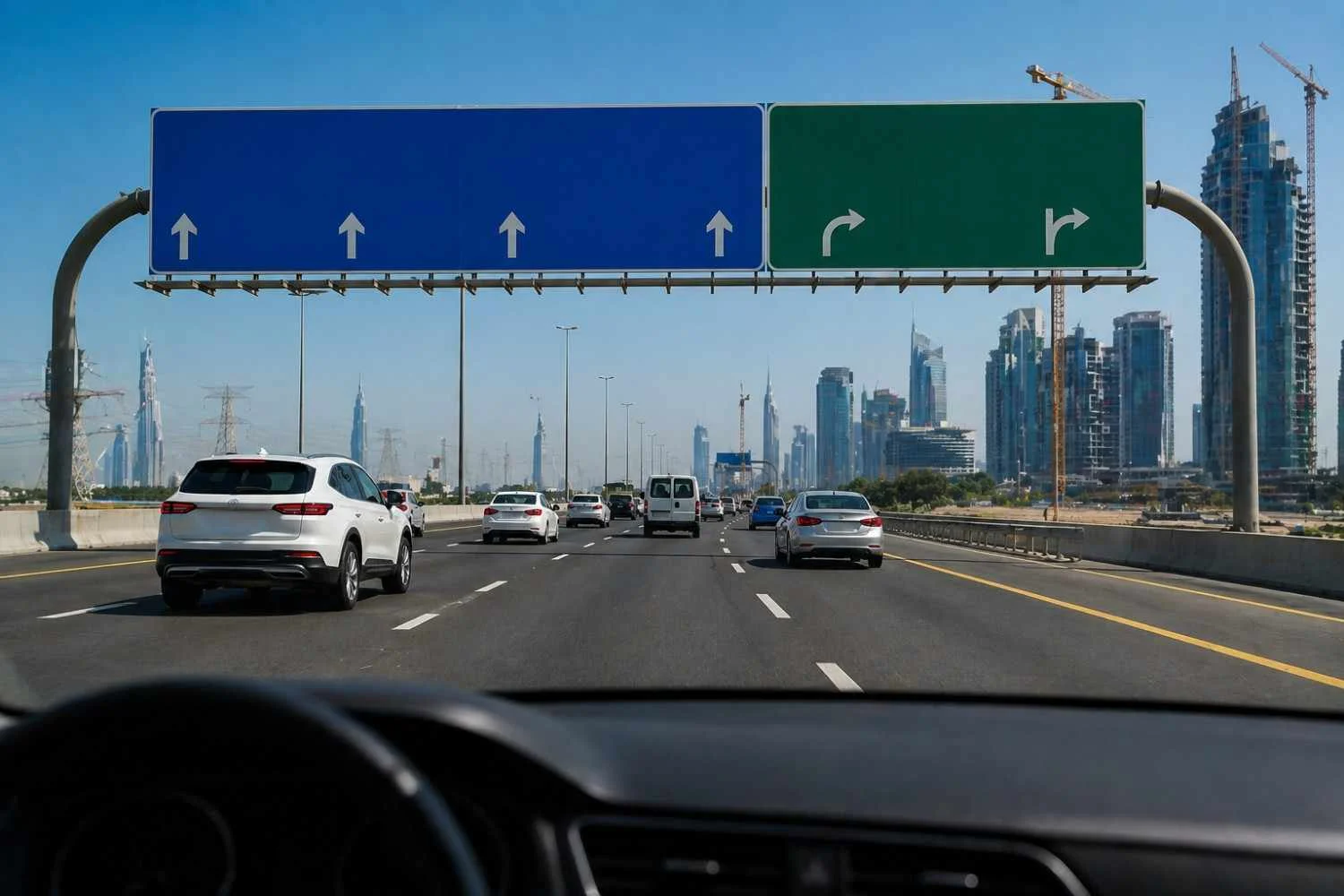
- Blue signs E-routes (Emirates routes), denoting roads of national and international importance that connect different emirates. Think of E11 (Sheikh Zayed Road) – blue signs lead you there.
- Green signs – D-routes and intra-emirate roads that stay entirely within one emirate.
- Brown signs – local wayfinding to places of local importance: heritage sites, parks, tourist attractions, hospitals.
- White signs – local street information, distances within a city or urban zone.
| Color | Route Type | Example |
|---|---|---|
| Blue | E-routes — inter-emirate expressways | E11, E311, E611 |
| Green | Intra-emirate roads | Dubai D-routes |
| Brown | Points of local interest | Heritage Village, hospitals |
| White | Local street-level info | Neighbourhood roads |
Route Numbering System
UAE classified roads follow a clear numbering convention:
- E-routes (e.g., E11, E311) are Emirates-wide roads connecting multiple regions
- D-routes (e.g., D89, D71) are Dubai-internal roads
- F-routes are Abu Dhabi-specific federal roads
Once you internalize this system, highway signage becomes intuitive. You know from a sign’s color whether you are on an inter-emirate expressway or a local road without reading the name.
Direction & Exit Signs
These guide signs help you prepare for lane changes well before an exit arrives. The UAE places advance guide signs well before exits watch for them at 2 km, 1 km, and 500 m intervals on major highways.
Trailblazing signs appear on highways and main routes, reassuring drivers mid-route that they are still heading in the right direction. You will see them pointing toward Dubai International Airport, major business districts, or key interchanges especially useful on long stretches of Sheikh Mohammed Bin Zayed Road where exits are spread far apart.
Warning Signs in UAE You Must Never Ignore
Warning signs are perhaps the most underestimated category. Drivers sometimes slow down for mandatory signs but skim past warning signs without adjusting speed or awareness. That is a mistake.
Animal Crossing – When Driving Near Animals This Sign Must Be Observed
This is one of the most specific and culturally significant road safety signs in the UAE: the animal crossing sign, and more specifically, the camel crossing sign.
The rule is simple: when driving near animals this sign must be observed without exception slow down immediately, increase your following distance, and scan both sides of the road. Many drivers who have lived in the UAE for years still underestimate how suddenly a camel can appear on a desert highway. The consequences of ignoring this sign are severe camels are particularly dangerous because:
- They are very large and can appear suddenly from desert terrain
- They tend to cross in groups, not alone
- Their dark coloring makes them hard to spot at night
- A collision with a camel at highway speed is almost always fatal
The animal crossing sign is triangular with a red border and shows a camel illustration. You will encounter it primarily in:
- Desert roads between emirates (particularly between Dubai and Fujairah)
- Rural areas in Ras Al Khaimah, Umm Al Quwain, and Al Ain outskirts
- Any road passing near farms or open desert land
When driving near animals this sign must be observed by reducing speed below the posted limit, keeping headlights on full beam at night, and not assuming the road is clear just because you cannot see an animal immediately. The RTA signs handbook specifically highlights this sign because it is unique to the UAE’s environment. When driving near animals this sign must be observed – not glanced at and forgotten.
Road Narrowing, Curves, Speed Bumps
These signs appear earlier than you might expect, giving you time to reduce speed gradually, move away from the road edge before it narrows, and prepare for a curve without fighting the wheel at highway speeds.
Construction & Hazard Zones
Temporary road works are common across the UAE as infrastructure expands. Construction zone signs will reduce posted speed limits, often to 60 km/h or even 40 km/h, and this reduction is enforced by cameras. “Temporary” radar speed traps within construction zones have caught many drivers off-guard. Follow construction zone signs precisely the lanes may shift, workers may be present, and road surfaces may be uneven.

Road Markings vs Traffic Signs (Important Difference)
Road markings and traffic signs work together one is not a substitute for the other. When I was learning to drive in the UAE, I made the mistake of relying heavily on overhead signs while ignoring what was painted on the road itself. That does not work.
The full picture of UAE’s sign system includes both the signs on poles and the markings on the tarmac regulatory signs above, road markings below, both legally binding.
Road markings are the lines, symbols, and colors painted on the road surface. They provide guidance when overhead or roadside signs are absent, and they reinforce the rules established by signs.
Key road markings in UAE:
- Solid white line – do not cross; lane separation or road edge
- Broken white line – lane change permitted when safe
- Yellow lines – parking and stopping restrictions (single yellow = restricted during certain hours, double yellow no stopping at all)
- White arrows on road – directional commands matching mandatory signs above
- Stop line – a thick white line; you must stop before this, not after
Curb colors in the UAE also carry meaning:
- Red and white curb – no stopping
- Black and white curb – parking regulated (check posted signs)
- Yellow curb – no parking
UAE Traffic Sign Colors & Shapes Explained
If you are preparing for the RTA theory test, mastering the color and shape system is the fastest path to correct answers. It is also genuinely useful on the road your brain processes color and shape faster than text at driving speeds.
This visual logic applies to all road safety signs in UAE, and it is the same system authorities use to make information instantly recognizable at highway speeds.
Shape Meanings
| Shape | Meaning |
|---|---|
| Circle (blue bg) | Mandatory action – you must do this |
| Circle (red border) | Prohibited – you must not do this |
| Triangle (red border) | Warning ahead – adjust your driving |
| Octagon (red) | Stop completely |
| Rectangle | Information or guide |
| Diamond | Hazard warning (less common in UAE) |
Color Psychology in Road Safety Signs
| Color | Function | Example |
|---|---|---|
| Blue circle | Mandatory – you must do this | Turn Right Only |
| Red border/circle | Prohibited – must not do this | No U-Turn |
| Red octagon | Stop completely | Stop Sign |
| Yellow/red triangle | Warning – hazard ahead | Curve, Animal Crossing |
| Blue rectangle | Information/direction | Inter-emirate E-route signs |
| Green rectangle | Intra-emirate direction | Dubai internal roads |
| Brown rectangle | Local point of interest | Heritage sites, hospitals |
| White | Local area information | Street signs |
Once these color-shape associations are in your memory, reading UAE roads becomes almost automatic. You do not need to read every word on a sign the color and shape tell you the category in under a second.
Common Mistakes Drivers Make with UAE Traffic Signs
After driving in the UAE for years and speaking with others who have navigated the licensing process, these are the mistakes that come up again and again. Every one of these mistakes involves ignoring or misreading mandatory signs UAE, RTA signs, or the signs placed there for a clear reason:
1. Ignoring Mandatory Signs UAE
The most common and most dangerous mistake. Drivers in a hurry sometimes decide a “Turn Right Only” mandatory sign does not apply to them because their destination is straight ahead. It does apply. Every time. These mandatory signs are not suggestions they are law.
2. Misreading Guide Signs and Missing Exits
Especially on E11 and E311, drivers miss exits because they were in the wrong lane 2 km back. Guide signs give you advance notice use that notice to position your lane early, not to make last-minute cuts across traffic.
3. Confusing Warning Signs with Prohibitory Signs
A triangle warning you of a curve ahead does not mean you cannot go straight. It means adjust your speed before you reach the curve. Misreading a warning as a prohibition or vice versa leads to unnecessary sudden braking or, worse, ignoring an actual restriction.
4. Not Stopping Fully at Stop Signs
A rolling stop slowing down but not coming to a complete halt is a violation. The Stop sign means wheels fully stopped, engine idling, before you proceed. Dubai’s intersection cameras detect rolling stops.
5. Parking in People of Determination Spaces
“Just for a moment” is not a legal defense. These spaces are reserved – full stop.
6. Ignoring Minimum Speed Signs
Most drivers watch for speed limits from above. Many miss the minimum speed signs, particularly on dedicated highway lanes. Driving significantly below the minimum can cause rear-end collisions.
Tips to Learn & Remember UAE Traffic Signs Fast
Whether you are preparing for the RTA theory exam or simply trying to feel more confident on the roads including situations like a Dubai Airport Transfer these methods work. Mastering road safety signs in UAE takes consistency not just cramming the night before your test.
For Driving Test Preparation:
Road signs make up roughly 30% of the UAE theory test. Start with the RTA theory test book download the PDF from the official RTA website. It contains color-coded charts and actual sign images used in the exam. The book covers mandatory signs UAE in full detail, along with every category of RTA signs you will encounter on real roads.
Apps and Mock Tests:
Use UAE-specific apps like the UAE Road Signs Quiz or RTA Signal Test. They offer practice questions in Arabic, English, and Urdu, with detailed explanations for each sign. Aim for consistent 90%+ scores in mock tests before sitting the actual exam.
Real-World Observation:
During your driving lessons and even as a passenger in someone else’s car start naming signs aloud as you pass them. This builds automatic recognition. When you see a blue circle, say what it is telling you. When you see a red triangle, identify the hazard it is warning of.
Pattern Recognition Over Text Reading:
At highway speeds, you cannot read text. Train yourself to react to shapes and colors first. Blue circle action required. Red triangle hazard ahead. This instinct is more valuable than memorizing words.
Walking Practice:
Sounds unusual, but walking through busy roads and identifying signs at a slow pace lets you study them without the pressure of driving. Test yourself on each sign’s category before checking its text.
Traffic Fines & Penalties Related to RTA Signs
The UAE takes traffic enforcement seriously, and the penalty system is designed to be a deterrent not just an inconvenience. Whether you violate mandatory signs UAE on a city road or ignore RTA signs on a freeway, the consequences are real and tracked automatically. Here is what you need to know:
Violating Mandatory Signs UAE
- Fines for disobeying mandatory signs can reach AED 1,000, depending on the sign and the emirate
- Black points are typically added alongside fines for regulatory sign violations
- Repeated violations escalate to license suspension
Running a Stop Sign
- In Abu Dhabi: AED 500 fine + 6 black points
- In Dubai: penalties can be higher, with possible vehicle confiscation for repeat offenses
- Camera enforcement at intersections means violations are detected automatically you will receive the fine before you arrive home
Speeding (Including Minimum Speed Violations)
- Fines range from AED 300 (less than 20 km/h over the limit) to AED 3,000 (exceeding the limit by 60 km/h or more)
- Severe overspeeding carries 23 black points and vehicle impoundment up to 60 days
Parking Violations
- No stopping/no parking violations fines from AED 400 to AED 1,000, plus possible towing fees
- Misusing People of Determination spaces: fines and potential black points
- Expired parking: AED 100-200 depending on the zone and emirate
The Black Points System
The UAE uses a federal black points system. Violations add points to your license:
- 24 points within one year : 3-month suspension (first time)
- Second accumulation : 6-month suspension
- Third accumulation : 1-year suspension + mandatory retraining course before license is reinstated
Black points remain on your record for 12 months. Some emirates run periodic reduction campaigns check with your local traffic authority for current programs.
Checking and Paying Fines
You can check your traffic fines and black points through:
- Dubai Police app or website
- Abu Dhabi Police e-services portal
- Ministry of Interior (MOI) website
- Emirates ID or plate number look-up
Unpaid fines can prevent vehicle registration renewal and driving license renewal.
Frequently Asked Questions
What are mandatory signs in UAE?
Mandatory signs in the UAE are circular signs with a blue background and white symbols. They indicate actions that drivers must take such as turning in a specific direction, going straight ahead, keeping to one side of the road, or maintaining a minimum speed. They are legally binding and ignoring them results in fines and black points.
What is the difference between mandatory and control signs?
Both fall under the regulatory signs category, but they serve different functions. Mandatory signs (blue circles) tell you what action you must take turn left, go straight, keep right. Control signs (like Stop and Give Way) manage right-of-way at specific points junctions, crossings, and intersections. Control signs are about priority; mandatory signs are about direction and action.
What are the main types of road signs in UAE?
UAE road signs fall into three broad categories: regulatory signs (which include mandatory, control, and prohibitory signs), warning signs (hazard alerts, always triangular), and guide signs (navigation and directional information, color-coded by route type). Parking control signs and freeway control signs are subcategories within the regulatory group.
When driving near animals this sign must be observed?
When driving near animals this sign must be observed immediately and without hesitation reduce speed, scan both sides of the road, increase following distance, and use full beam headlights at night. The animal crossing warning sign (especially the camel crossing sign) is triangular with a red border.
How do guide signs help drivers in UAE?
Guide signs provide navigational information where to turn, which lane to use, how far the next city is, where the exit is. They use a color-coded system: blue for E-routes (inter-emirate), green for intra-emirate roads, and brown for local points of interest. They appear at regular intervals on highways to reassure drivers mid-route and give advance warning before exits.
What are traffic fines for ignoring road safety signs?
Fines vary by violation and emirate. Ignoring mandatory signs can result in fines up to AED 1,000. Running a Stop sign in Abu Dhabi is AED 500 plus 6 black points. Speeding fines range from AED 300 to AED 3,000 depending on severity. Parking violations range from AED 400 to AED 1,000, with possible towing. Accumulating 24 black points leads to license suspension. All violations are tracked through smart camera systems.
Final Thoughts
When I think back to that first shaky drive on Sheikh Zayed Road, what changed my driving the most was not the fines I was afraid of it was genuinely understanding what each sign was trying to tell me. A blue circle is not a bureaucratic instruction. It is a piece of information the road is sharing with you so that your journey and everyone else’s around you goes safely.
The UAE has built one of the most structured, internationally aligned traffic sign systems in the world. Bilingual. Color-coded. Shape-coded. Backed by law and enforced by technology.
Whether you are studying for your RTA theory test, preparing for your first drive across an emirate, or simply trying to become a more confident driver, mastering mandatory signs UAE, road safety signs, guide signs, and RTA signs is the foundation of every good decision you make on the road. Remember: when driving near animals this sign must be observed, and every road safety sign placed by the Roads and Transport Authority carries the full weight of UAE federal law.
Learn the blue circles. Respect the red triangles. Follow the colored guides. And whenever you see that camel crossing sign in the desert slow down, eyes wide open.


